
Understanding eKYC: Why Some Countries Require ID Verification

You are ready to leave home for your trip; flights are booked, the itinerary is planned, outfits are lined up, hotels are booked, and Travel eSIM is purchased. Then, right before departure, you get a message: ‘Identity verification required to activate the plan.’
That’s ALL, no other explanation. Fear and confusion rise in you; you realise that there is a request for passport photos and a countdown breathing down your neck.
You should not panic and start thinking something has gone wrong; are you getting scammed? Why is the paperwork required?
It is not a red flag; it is not just you; it is called eKYC, and it is for countries that treat mobile service as any other regulated service. And for those countries, you need to go through identity verification.
Verification is not a problem; the problem is the fact that travellers do not discover it at the right time. It usually becomes stressful because you would be racing against time before the deadline of the departure. Delaying the process could add to your travel stress due to waiting in the queue for last-minute verification.
What is eKYC Actually?
Full form of KYC is 'Know Your Customer ’, it is a compliance standard that is practised in a lot of countries across banking, telecommunications, and finance. This is the process of verifying that the individual using the services is indeed the one they claim. eKYC is its digital version where, rather than having to provide a physical ID, a photo of one's passport is uploaded, and a verification process is done remotely.
This is not a SIMZY policy but a regulatory one established by the respective country the person is travelling to. Certain governments require this for any type of mobile connection to be activated within the country, be it physical or digital. When a package for this region indicates that it requires eKYC, this means it is required regardless of any specific brand, and it's required from the place where you purchased the package. Consider it more like a requirement determined by the country, like a visa application and not a hoop the company forces you to jump through.
A few things worth knowing about how it works:
1. Generally, all you have to provide is a good-quality photograph of the biographical section of your passport; you need not be physically present or have to visit a notary public.
2. The review takes several days, but it may take longer if the picture is unclear or unreadable.
3. This is only applicable for select destinations that have such regulations in place, and in a vast majority of countries covered by SIMZY Travel eSIM, there are no such requirements.
4. After completing eKYC, travelers can select a suitable SIMZY travel eSIM plan based on their destination, data needs, and trip duration.
If you time it right, you can incorporate identity verification into the process of getting set up rather easily.
1. Verify before you take a chance: Make sure you see the verification flag in your plan details (Daily Pass, Nomad Plan, Smart Business, or regional bundle) so that you don’t find yourself guessing.
2. Apply ahead of time: Make sure you complete the verification process before travelling, allowing yourself at least a week in advance, to avoid issues like blurry pictures or cropped passport edges leading to you being late on launch day.
3. Buy in advance and activate later: With SIMZY's flexible mode of operation, you can finish your eKYC well in advance. You may decide on the timing of the plan activation, but you will still benefit from the buy-now-activate-later concept.
4. Do not disconnect your primary number: Your home phone will continue to operate for calls, messages, and 2FA codes as you go through the process of getting your travel data plan approved.
Ready to get connected? Explore the available SIMZY eSIM plans and choose the option that fits your trip.
Dealing with eKYC is just like applying for a visa: straightforward, standardized, and completely commonplace when done in advance. If you check your plan details, send in clear passport photographs at least a week before travel, and keep your primary line operational, then the stress of activation is out of your mind; you can start using your travel data as soon as you land at your destination.
eKYC makes eSIM activation more secure and convenient. Once verification is complete, you can choose a SIMZY eSIM plan and get connected for your international trip.
Keep reading

Best eSIM for Japan in 2026: Stay Online from Narita to Kyoto
Find the best eSIM for Japan in 2026. Compare data plans, coverage, prices and setup tips to stay connected from Narita to Kyoto with SIMZY.
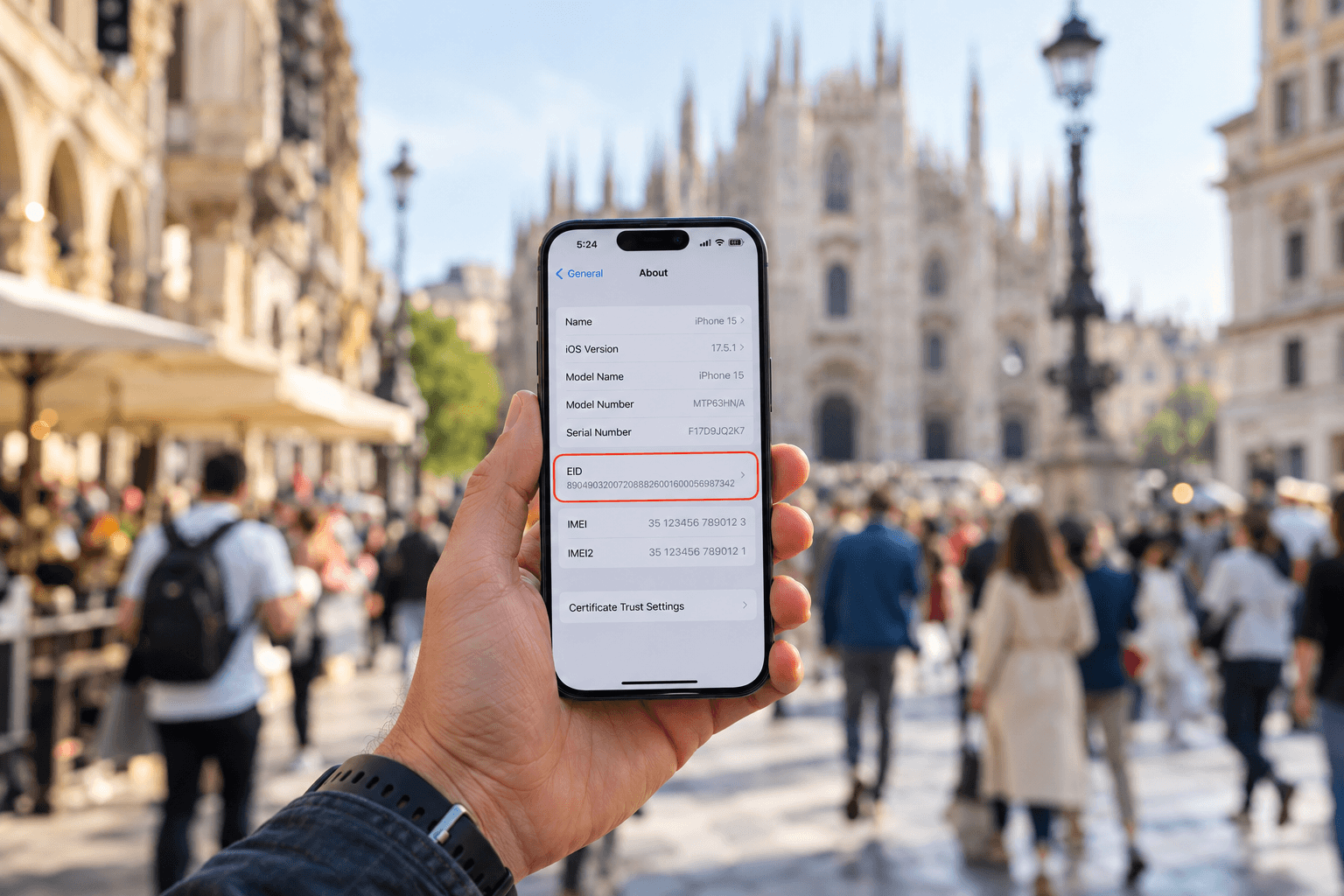
What is an EID number and how do you find it?
Learn what an EID number is, where to find it on iPhone and Android, and how it helps activate an eSIM. Get connected with a SIMZY eSIM today.

Will You Be Impacted by the Turkey eSIM Block? What Travelers Should Know
Is there an eSIM ban in Turkey? Learn about Turkey's eSIM restrictions, what they mean for travelers, and how to stay connected during your trip.